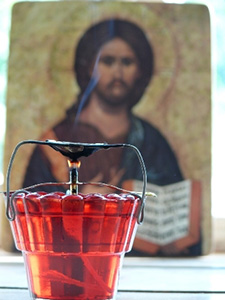
“Your word is a lamp to my feet and a light to my path.”
— Psalm 119:105
What we want, say or do in everyday life is often so different from what we know about God, faith, Christ and his teaching, as if the head were very far from the heart. Descending from the mind into the heart — these few dozen centimetres may be the longest journey in a Christian's life.
As Christians we have a fundamental longing for God. Somewhere deep inside we truly thirst for him. Yet our everyday desires often point elsewhere. We know that Christ is the way, but we turn into so many side streets that at the end of the day we have got no further. “Seek first the kingdom of God…” This does not mean living without everyday desires, but aligning them, like a compass needle, with the great meridian towards God. One of the most fruitful methods of holy living, tested over centuries, is the retreat.
Retreats
A retreat is a time when a Christian steps away from everyday duties to give full attention to prayer and contemplation. Retreats can be made in a retreat house or in everyday life alongside work and study. They can last from a weekend to the full Spiritual Exercises of 35 days in solitude and silence. Broadly, retreats are either preached or individually guided.
In a preached retreat the leader works with the participants as a group, giving talks that they then contemplate, discuss and pray about. The fruit of such retreats depends greatly on the leader's charisma, and experience shows that it tends to fade. In an individually guided retreat the leader's role is far less visible. What matters most happens in the conversation between the Creator and his creature. The leader does not preach or teach, but listens to what the person shares about their prayer and helps them understand, deepen and strengthen it. This kind of retreat is more fruitful: what the participant gains is more lasting and personal, because it comes from their own conversations with God. God can reveal more to a person than the most brilliant talk.
One of the best-known forms is the Ignatian retreat, which our church is gradually coming to know. It is named after Ignatius of Loyola, who in the 16th century wrote the famous Spiritual Exercises: a four-week series of meditations on Bible texts, mainly on the events of the life of the Lord Jesus. Ignatius himself describes the exercises as “every way of examining one's conscience, of meditating, of contemplating, of praying vocally and mentally, and other spiritual activities … to rid oneself of all disordered attachments and, having done so, to seek and find the will of God in one's life.”
Meditation
At the centre of a retreat, especially an individually guided one, there is usually meditation. The word is used for many different things. In Ignatian retreats meditation means a particular way of reading and contemplating Holy Scripture. Martin Luther, too, understood meditation as a kind of Bible contemplation known as divine reading, or lectio divina. He teaches: “You should meditate not only in your heart but also outwardly, by repeating the words aloud and rubbing the written word like a sweet-smelling herb, carefully and attentively, reading and rereading it to grasp what it means.”
In his commentary on Deuteronomy, Luther compares this meditation to a cow chewing the cud: “To chew the cud means to take up the Word with joy and to meditate on it with the greatest diligence, so that it does not, as the saying goes, go in one ear and out the other, but is held fast in the heart, swallowed and absorbed.”
Guigo II, the 12th-century Carthusian prior of Chartres, gives similar guidance: “Reading puts the food (the nut) into the mouth, meditation chews it and breaks it up, prayer extracts its flavour, and contemplation is the sweetness itself that gladdens and refreshes.”
Technically, lectio means reading a Bible text very slowly, constantly listening to one's heart and noticing how it responds to the word. If a word or sentence “surfaces” from the text, stands out from the rest and echoes in the soul as surprise, awe, sorrow, regret, joy and so on, we stop and “taste” that word, speak about it with God and let God speak to us. And we simply enjoy God's presence for as long as it is given. Then we read on to the next special word. Lectio is not simply reading but an inspired reception of an inspired text. The Spirit who inspired the writing of Scripture lives in us, as Jesus promised, and inspires our reading too: breathes into it, breathes the living reality of the divine Speaker “into our nostrils”, so that the written word begins to live. Overall, the aim of lectio is not to analyse the word but to personalise and realise it: God speaks to me personally and really, here, at this very moment. I let his word act on my feelings and my will. Lectio divina is usually used to meditate on Old Testament texts and the apostles' letters.
The second kind of meditation is imaginative contemplation, usually used for the events of Jesus' life. The 14th-century Carthusian monk Ludolph of Saxony writes: “If you want to draw fruit from the mysteries of Christ's life, hear and see the things narrated as if you heard them with your own ears and saw them with your own eyes; for these things are sweetest to the one who thinks on them with longing, and still more to the one who tastes them. And although much of it is told as past events, you must meditate on it all as happening at this moment; for in this way you will certainly taste a greater sweetness. Read what was done as if it were happening now. Bring past events before your eyes as if they were present. Then you will feel how full they are of wisdom and delight.”
We use the blessed gift of imagination to enter so deeply into a Gospel event that we become one of those taking part. We look, listen, touch, smell and taste. The aim is to meet Jesus in the event we are meditating on, to watch him and to speak with him. This lets us come to know him in the heart more closely than would otherwise be possible.
Conversations with the leader
In an individually guided retreat the most important thing is that God comes to the prayer. If God does not come, the leader cannot help. But experience shows that God is faithful in this too, and the one who prays receives his presence as consolation. Sometimes it is very intense, but more often it comes as light touches on the soul. The leader's task is to help notice them, recognise them, experience them more deeply and strengthen them. The leader only helps to observe. The main thing happens as the retreatant contemplates God. How did he reveal himself in prayer? What does Jesus do? How does he do it? How does it make me feel? Watching Christ helps the shoots of love for him to grow. That is the main purpose of a retreat: to know Jesus more deeply in the heart, to love him more fully and to follow him more closely.
The Spiritual Exercises are especially suited to life's crossroads, when a decision about one's calling must be made, or at other decisive moments. Spending four weeks in silence, reading, praying and meditating five to seven hours a day, it is impossible to pretend or dodge before God. All the compacted layers and concrete sarcophagi in the soul are broken open. What one sees can be shattering. But God does not leave us in despair; he gives consolation abundantly and the sweetness of his presence. The full Exercises are the “heavy artillery”: few make them, and only once or twice in a lifetime. Today an Ignatian retreat usually means eight days in silence, reading and praying in the way described above.
Retreats as a tool for mission
If circumstances do not allow, or there is no wish, to go away into solitude and silence, a retreat can be made alongside one's daily work. A week of guided prayer is a retreat made without interrupting work or study: each day the participant commits to half an hour of meditation and a conversation with the leader about what they experienced. It can also be offered to people who are not members of a congregation. In this way retreats can be one of the directions of a congregation's mission.
Archbishop emeritus Jānis Vanags
The article was prepared using materials published by the LELB.